Governance
An assistant that answers questions about your data is only useful if someone can stand behind its answers. This section is for the person who has to: a chief data officer, a data governance lead, the owner of a team's definitions.
Qry answers seven questions about itself.
| The question | Where Qry answers it |
|---|---|
| How was this answer made? | Under every answer: the model, the datasource and schema, each query with its outcome, the skills at the version in force, and the metric views and documents it used. How an answer was made |
| Does it still give the same figure? | Run again repeats an answer's query against today's data — without the model — and says what changed. How an answer was made |
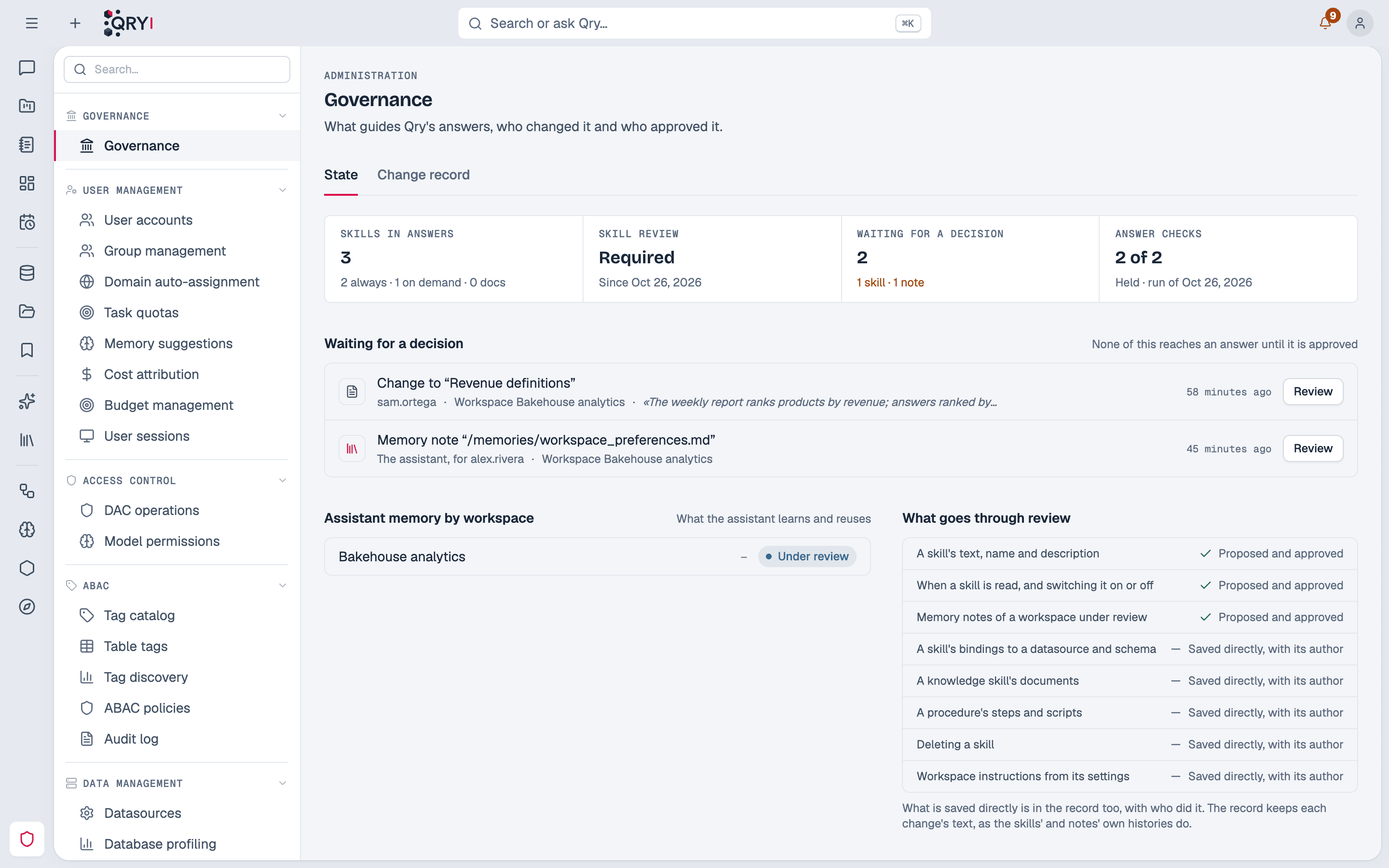
| Who decides what guides the answers? | Changes to shared skills and to a workspace's assistant memory can go through review: someone proposes, the people who own it approve. Reviewing skill changes · Assistant memory |
| Who changed what, and who approved it? | Admin › Governance shows what guides answers today and keeps a record of every change, with the text before and after. The change record |
| Is our data ready for an assistant? | Each schema's readiness: descriptions, codes explained, rules, checks and use — and what is missing first. Qry drafts the missing descriptions for someone to approve. Readiness for AI |
| Which tables answer a business question? | Domains give data areas the names people use — Hotel bookings — with what they answer, a steward and their tables; a conversation can ask in one. Business domains |
| Are the answers still right after a change? | People rate answers, and the answers that matter become answer checks that Qry asks again after a new model, a skill change or an upgrade. Ratings and answer checks |
What guides an answer
Three things shape what Qry answers, besides the data itself and the person's permissions:
- Skills — your organisation's definitions, rules and procedures, written once ("revenue is the sum of
totalPrice", "a franchise is named by its name, never its ID"). A skill applies to the whole installation, a datasource, a workspace or one person. See Skills. - The assistant's memory — what the assistant notes down as it works in a workspace, and reads in later answers.
- The model — which one answered, chosen by the person or by the installation's defaults.
Governance in Qry is about those three: seeing which ones reached an answer, controlling who may change them, and noticing when a change makes answers worse.
What it does not replace
- Data access is not governance's job here. Who may read which table is decided by grants, attribute-based row filters and, on Databricks, the person's own identity. Every query in every answer — and in every Run again and answer check — goes through those checks.
- Personal skills and personal memory are not reviewed or recorded. They reach only their owner's answers.
- Not every change goes through review. A skill's bindings, a knowledge skill's documents, a procedure's steps and scripts, deleting a skill and the workspace's instructions box are saved directly — and recorded, with who did it. The list is on the page Qry shows administrators too.
- The record lives in Qry's database. It is complete for what it covers, but it is not a tamper-proof ledger: someone with direct access to the database could change it.
Where to start
- Turn on skill review if more than one person edits shared skills.
- Put the workspaces whose memory matters in Review first.
- Turn the answers people rate well into answer checks, and run them after every model or skill change.
- Look at Admin › Governance now and then: what waits for a decision, and what changed.
- Open Readiness, start with the most asked schemas, and fill their gaps — the first one adds the most.
- Create domains for the areas people ask about most, with what each answers and its steward.